Common Pharmaceutical Packaging Defects
Quality control is critical in pharmaceutical manufacturing. A small packaging defect—such as an incorrect label, damaged cap, missing component, or improperly sealed container—can result in rejected products, production delays, recalls, and potential risks to patients.
As pharmaceutical production becomes faster and more automated, manufacturers need inspection methods capable of consistently examining large volumes of products while identifying defects that may be difficult to detect reliably through manual inspection alone.
Automated vision inspection systems use industrial cameras, controlled lighting, sensors, image-processing software, and increasingly AI-based vision tools to inspect pharmaceutical products and packaging at production speed.
Depending on the application, these systems can verify labels and printed information, check components and closures, measure dimensions, detect cosmetic defects, and automatically reject products that do not meet established inspection criteria.
Below are some common pharmaceutical packaging defects and how automated vision inspection can help detect them.
1. Missing or Incorrect Labels
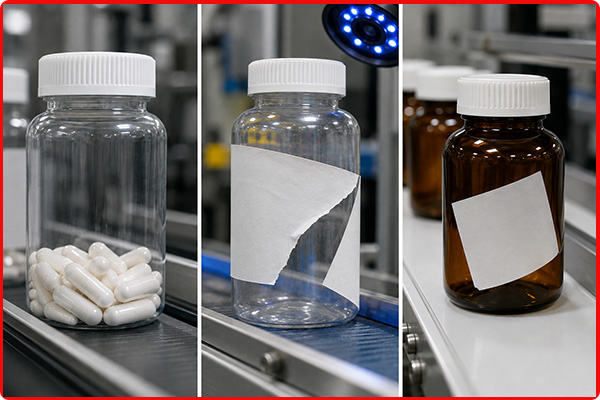
Labels contain critical product information such as:
• Product name
• Strength and dosage
• Lot or batch number
• Expiration date
• Barcode or 2D code
• Manufacturer information
A missing, incorrect, misplaced, or damaged label can create significant quality and traceability problems.
How Automated Vision Inspection Detects It
A vision system can capture images of each package and compare label presence, position, orientation, and other visual characteristics against predefined acceptance criteria.
Depending on system configuration, inspection can include:
• Label presence
• Label positioning
• Label orientation
• Skewed labels
• Damaged or folded labels
• Incorrect label variants
• Barcode and 2D-code verification
Products that fail inspection can be automatically identified and rejected from the production line.
2. Incorrect or Unreadable Lot and Expiration Codes
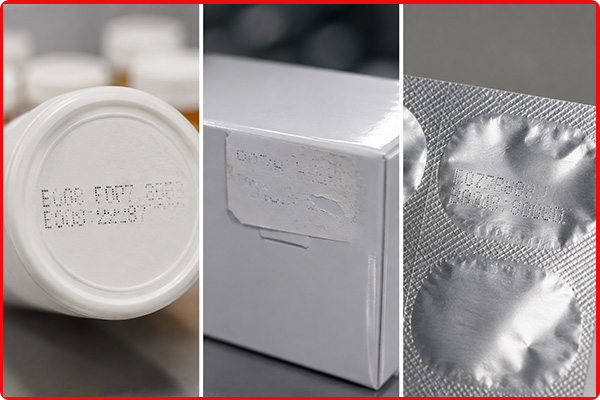
Lot numbers and expiration dates are essential for pharmaceutical traceability.
Printing problems can result in codes that are:
• Missing
• Incomplete
• Blurred
• Poorly positioned
• Incorrect
• Difficult to read
How Automated Vision Inspection Detects It
High-resolution cameras can inspect printed information immediately after printing or at a downstream inspection station.
Machine-vision software can verify the presence and quality of printed characters, while OCR (Optical Character Recognition) and OCV (Optical Character Verification) can be used in suitable applications to read or verify characters against expected information.
This allows manufacturers to identify coding problems before affected products continue further into packaging or distribution.
3. Missing or Misaligned Caps and Closures
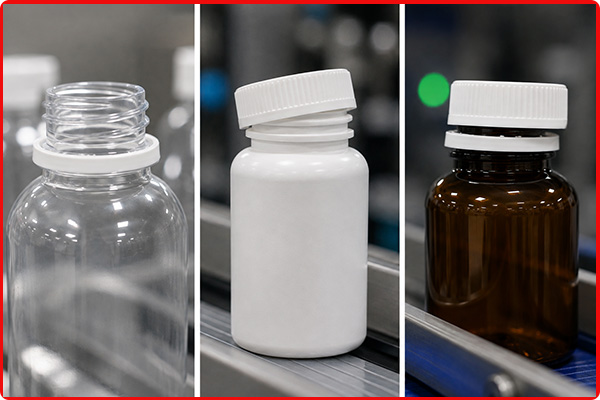
Caps, stoppers, crimp seals, and other closure components play an important role in pharmaceutical packaging.
Potential defects include:
• Missing caps
• Tilted caps
• Improperly positioned closures
• Missing stoppers
• Damaged caps
• Incorrect cap type
• Improper crimp appearance
How Automated Vision Inspection Detects It
Multiple cameras can inspect a container from different angles to determine whether the required closure is present and positioned correctly.
Vision algorithms can compare dimensions, position, shape, height, and other visible characteristics against established tolerances.
This makes it possible to identify closure abnormalities automatically before the product leaves the inspection station.
4. Damaged Bottles, Vials and Containers
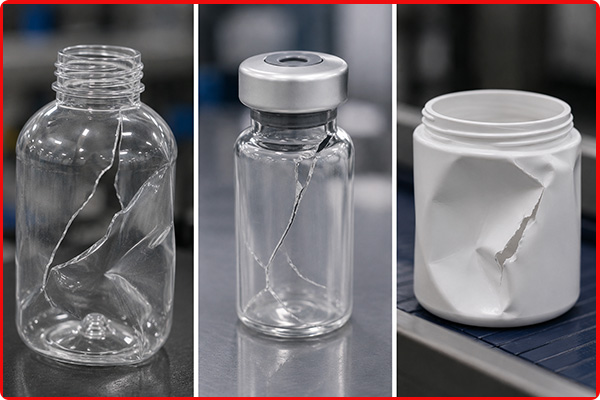
Pharmaceutical containers can develop physical or cosmetic defects during manufacturing, filling, handling, or transportation within the production line.
Examples include:
• Cracks
• Chips
• Scratches
• Deformation
• Surface damage
• Damaged edges
• Abnormal container geometry
For injectable products in particular, container and closure abnormalities can be important quality concerns.
How Automated Vision Inspection Detects It
Carefully positioned cameras and lighting can highlight surface and geometric abnormalities.
Different lighting techniques—including backlighting, directional illumination, and diffuse lighting—can be selected according to the material and defect being inspected.
The vision system analyzes the captured images and identifies units that differ from validated acceptance criteria.
5. Seal Defects
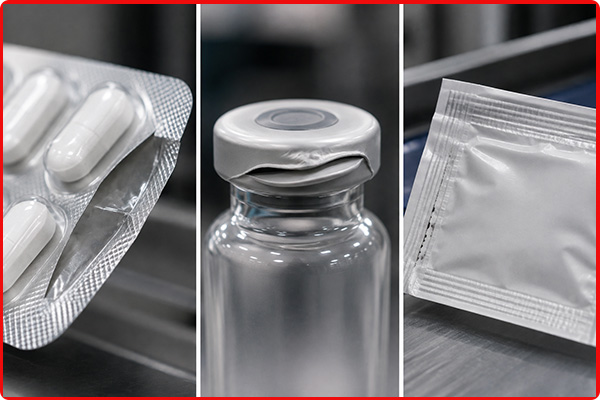
Package seals help protect pharmaceutical products from contamination, moisture, and environmental exposure.
Depending on the packaging format, defects may include:
• Incomplete seals
• Wrinkles
• Folded material
• Contamination within the seal area
• Misaligned seals
• Damaged sealing surfaces
• Open or visibly compromised packages
How Automated Vision Inspection Detects It
Machine-vision systems can inspect visible characteristics of seal areas for irregularities in shape, continuity, position, and appearance.
For transparent or visually accessible packaging, appropriate lighting can make certain seal defects easier to identify.
It is important to distinguish visual seal inspection from a validated package-integrity or leak test. Vision inspection can identify visible abnormalities but does not automatically prove package integrity unless the specific system and method have been validated for that purpose.
6. Blister Pack Defects
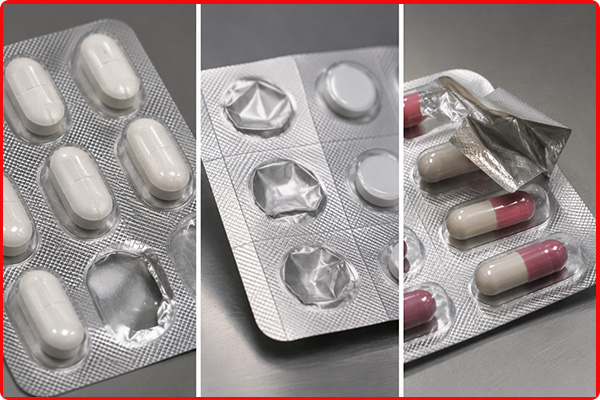
Blister packaging is widely used for tablets and capsules, and several defects can occur during filling and sealing.
Common defects include:
• Missing tablets or capsules
• Multiple products in one cavity
• Broken tablets
• Incorrect product
• Improper orientation
• Damaged blister cavities
• Foreign material
• Seal-area abnormalities
How Automated Vision Inspection Detects It
A camera can inspect every blister cavity before or after sealing, depending on the application.
Image-processing algorithms can verify:
• Product presence
• Number of products
• Shape
• Size
• Position
• Color
• Visible damage
AI-based inspection can also be considered for applications involving greater product or defect variability.
7. Missing Components
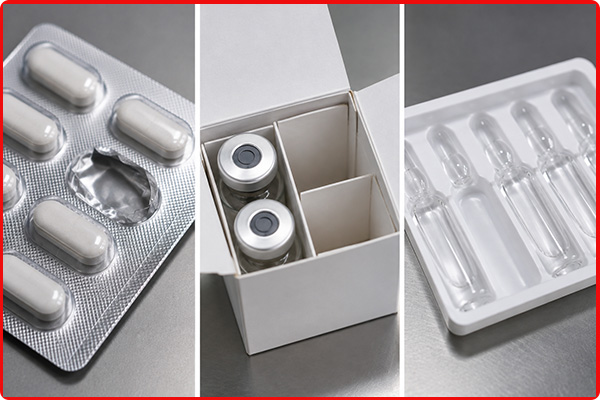
Pharmaceutical packages may contain multiple components, such as:
• Bottles
• Caps
• Droppers
• Applicators
• Syringes
• Instruction inserts
• Trays
• Other packaged components
A missing component can make the final product incomplete.
How Automated Vision Inspection Detects It
Machine vision can perform presence/absence inspection to verify that required components are in their expected positions.
Instead of relying solely on operators to identify missing components, every package can be inspected according to predefined criteria before proceeding to the next manufacturing or packaging stage.
8. Incorrect Product or Packaging Variant
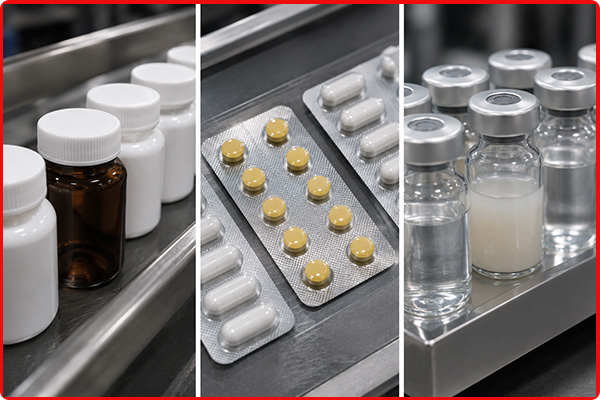
Pharmaceutical facilities may manufacture multiple products or packaging configurations on the same equipment.
This creates the possibility of incorrect components or packaging variants entering production.
Examples include:
• Wrong cap color
• Wrong bottle
• Incorrect label
• Incorrect carton
• Different tablet or capsule appearance
• Incorrect packaging component
How Automated Vision Inspection Detects It
Vision systems can compare characteristics such as:
• Color
• Shape
• Dimensions
• Printed graphics
• Labels
• Component geometry
• Identifying features
This provides an additional automated check for detecting visually distinguishable product or packaging mix-ups.
9. Fill-Level Abnormalities
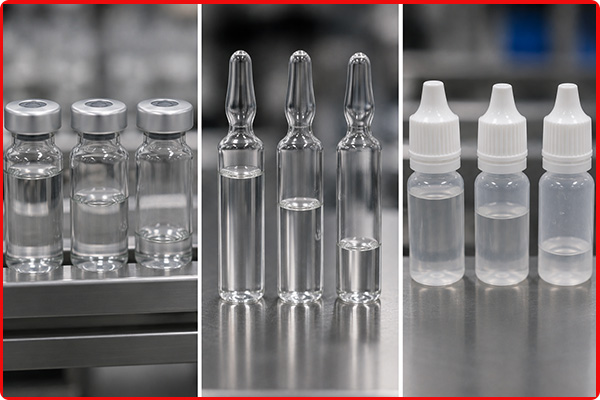
For products packaged in transparent or sufficiently inspectable containers, incorrect fill levels may sometimes be detectable visually.
Possible issues include:
• Underfilled containers
• Overfilled containers
• Empty containers
• Significant fill-level variation
How Automated Vision Inspection Detects It
With controlled backlighting and calibrated imaging, a vision system can locate the visible liquid boundary and compare its position with established limits.
Containers outside the acceptable visual range can then be automatically rejected.
The feasibility and accuracy of this approach depend strongly on the product, container geometry, transparency, foaming, bubbles, opacity, and other application-specific factors.
10. Visible Foreign Particles
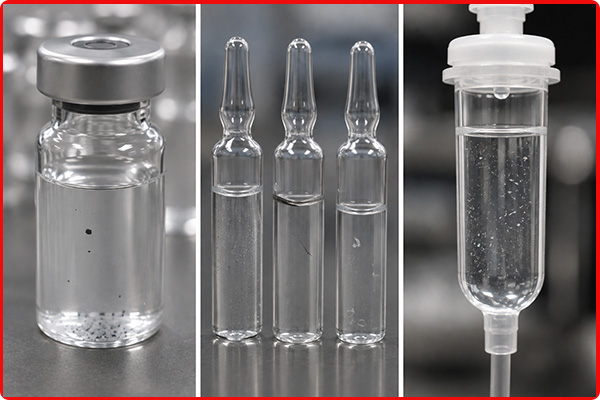
Visible particulate contamination is particularly important for injectable pharmaceutical products.
Examples of extraneous particulate matter can include materials such as fibers, glass, metal, elastomeric material, or other visible foreign matter.
How Automated Vision Inspection Detects It
Automated visual inspection systems designed specifically for this application may use specialized lighting, cameras, container handling or rotation, and image-processing algorithms to distinguish moving particles from the product and container background.
This is a specialized pharmaceutical inspection application. Detection capability depends on factors including particle size, shape, color and density, as well as the product formulation and container design.
Any automated system used for pharmaceutical particulate inspection therefore needs to be appropriately developed, challenged, qualified, and validated for the specific application.
Manual Inspection vs. Automated Vision Inspection
Human visual inspection remains important in many pharmaceutical manufacturing processes, but inspection performance can be influenced by factors such as fatigue, inspection duration, defect characteristics, and viewing conditions.
Automated vision inspection offers several potential advantages for suitable applications:
• Consistent inspection criteria
• High-speed inspection
• 100% inspection of selected attributes
• Repeatable image acquisition
• Automatic defect rejection
• Reduced dependence on repetitive manual inspection
• Collection of inspection data
• Defect images for analysis
• Improved production traceability
• Integration with automated manufacturing equipment
Automated inspection does not simply mean installing a camera. The camera, lens, lighting, part presentation, software, reject mechanism, acceptance criteria, and validation strategy all need to work together as a complete inspection process.
The Role of AI in Pharmaceutical Vision Inspection
Traditional machine vision is highly effective when defects can be defined using clear rules—for example, checking whether a cap is present or whether a label is positioned within a specified area.
Some defects, however, have substantial variation in shape, texture, position, or appearance.
In these applications, AI-based vision inspection may provide additional capabilities by learning visual patterns from representative examples.
AI can potentially assist with applications involving:
• Complex surface defects
• Cosmetic defects
• Variable defect appearances
• Product classification
• Packaging anomalies
• Defects that are difficult to describe with simple rule-based algorithms
Traditional machine vision and AI do not necessarily compete with each other. A well-designed inspection machine may combine both approaches depending on the application.
Building an Automated Pharmaceutical Inspection System
Every pharmaceutical inspection application is different.
The appropriate inspection solution depends on factors including:
Product → Packaging → Defect → Required resolution → Production speed → Part presentation → Lighting → Camera → Software → Reject mechanism → Data requirements
Before developing an automated inspection system, representative good and defective samples should be evaluated whenever possible.
This helps determine whether the defect is visually detectable and what combination of cameras, optics, lighting, handling, and software is appropriate.
Automated Vision Inspection Solutions from SORSYS
SORSYS Technologies develops customized automated quality inspection and machine-vision systems for manufacturing applications.
Depending on the application, an inspection system can integrate:
• High-resolution industrial cameras
• Specialized lighting
• Multiple inspection stations
• Traditional machine-vision algorithms
• AI-based vision inspection
• Automated product handling
• Feeding and orientation systems
• Automatic reject mechanisms
• Inspection data collection
• Custom automation
For pharmaceutical and healthcare manufacturing applications, the inspection approach can be developed around the product, packaging format, target defects, production requirements, and customer's quality requirements.
Have a Pharmaceutical Product or Package That Needs Automated Inspection?
Send us representative samples and tell us what defects you need to detect.
The SORSYS team can evaluate your application and determine whether automated vision inspection is suitable for your product.
Contact SORSYS for a free initial consultation and application review.