Torsion springs store rotational energy. They twist around their axis rather than compress or stretch.
Torsion springs are commonly used in vehicle tensioners, latches, and many rotating mechanisms.
Constant force springs deliver nearly the same force throughout their entire range of motion.
Typical Applications
• Retractable seat belts
• Window shades
• Medical devices
• Cable management systems
• Electronic equipment
5. Spiral Springs
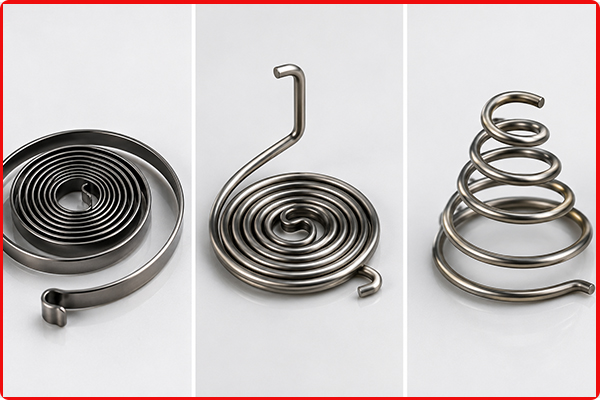
Spiral springs store energy through rotational winding.
Typical Applications
• Clocks
• Measuring tapes
• Retractable mechanisms
• Precision instruments
6. Wire Forms Springs
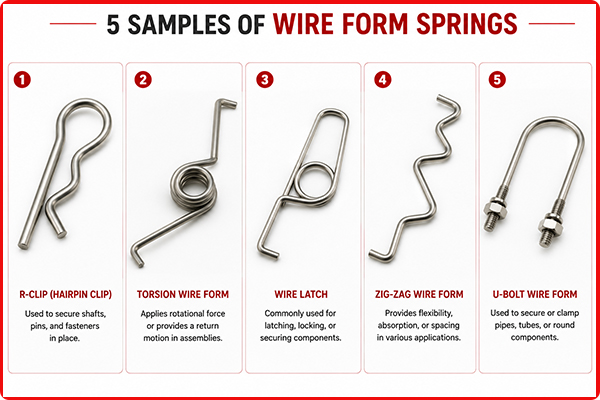
Wire forms are custom-bent wire components that provide spring action while performing mechanical functions.
Applications
• Automotive clips
• Retaining mechanisms
• Medical devices
• Electronics
• Industrial fixtures
Liberty Spring also manufactures wire forms and several specialty spring designs for automotive and industrial applications.
Industries That Depend on Springs
Industrial springs are found in nearly every manufacturing sector.
Industry, Typical Applications
Automotive: Suspension, braking, transmission, engines, seats, door latches
Aerospace: Landing gear, actuators, control systems
Medical: Surgical tools, insulin pumps, diagnostic devices
Electronics: Switches, connectors, battery contacts
Agriculture: Harvesters, tractors, planting equipment
Industrial Automation: Pneumatic cylinders, robotics, conveyors
Construction: Power tools, heavy equipment
Consumer Products: Appliances, locks, furniture, toys
Common Spring Manufacturing Defects
Even small manufacturing defects can dramatically reduce spring life or cause complete failure.
1. Bent Springs
Causes
• Improper forming
• Handling damage
• Machine misalignment
Risks
• Assembly problems
• Uneven loading
• Premature fatigue
• Product malfunction
2. Burrs
Small sharp metal edges left after grinding or cutting.
Risks
• Cuts during assembly
• Poor seating
• Accelerated wear
• Stress concentration
• Component damage
3. Incorrect Free Length
The spring is manufactured longer or shorter than specification.
Risks
• Incorrect operating force
• Improper preload
• Product malfunction
• Reduced performance
4. Incorrect End Grinding
Ground ends are not square or aligned correctly.
Risks
• Uneven load distribution
• Tilting
• Vibration
• Reduced fatigue life
5. Surface Cracks
Tiny cracks caused during forming or heat treatment.
Risks
• Fatigue failure
• Sudden breakage
• Safety hazards
6. Corrosion
Improper material selection or damaged coating.
Risks
• Reduced spring strength
• Fatigue cracking
• Premature failure
7. Wrong Wire Diameter
Even small dimensional variations change spring force.
Risks
• Product out of specification
• Assembly failure
• Reduced performance
8. Heat Treatment Problems
Improper tempering changes mechanical properties.
Risks
• Loss of elasticity
• Permanent deformation
• Early fatigue failure
9. Mixed Parts
Springs from different production batches or specifications become mixed.
Risks
• Incorrect assembly
• Inconsistent product performance
• Warranty claims
Why Defective Springs Are So Dangerous
Unlike cosmetic defects, spring defects often lead directly to mechanical failure.
Possible consequences include:
• Vehicle suspension failure
• Brake system malfunction
• Engine valve timing issues
• Medical device failure
• Industrial machine downtime
• Product recalls
• Warranty costs
• Customer complaints
• Safety incidents
• Damage to brand reputation
Because springs repeatedly cycle under load, even microscopic defects can grow over time and eventually cause catastrophic failure.
The Challenge of Manual Inspection
Traditional visual inspection depends on operators to identify defects.
This approach presents several challenges:
• Human fatigue
• Inconsistent decisions
• Limited inspection speed
• Difficulty detecting tiny defects
• High labor costs
• Sampling instead of 100% inspection
As production volumes increase, manufacturers require automated solutions that inspect every part without slowing production.
How AI-Powered Automated Inspection Improves Spring Quality
Modern machine vision systems inspect every spring with consistent accuracy.
Automated inspection systems can verify:
• Free length
• Overall dimensions
• Spring orientation
• Grinding quality
• Burrs
• Bent springs
• Surface damage
• Missing features
• Mixed parts
• Dimensional tolerances
Unlike manual inspection, AI-powered vision systems operate continuously with repeatable accuracy while generating traceable quality data for every inspected part.
How SORSYS Technologies Inspects Springs
SORSYS Technologies develops automated AI-powered vision inspection systems for manufacturers producing precision components. Its C-300 Spring Inspection System is specifically designed for compression springs and uses four high-resolution cameras to inspect each part from multiple angles. The system can:
• Measure spring free length within ±100 microns
• Detect bent springs
• Identify burrs on ground ends
• Verify grinding depth and orientation
• Automatically separate conforming and non-conforming springs
• Perform 100% inspection without slowing production
Beyond spring inspection, SORSYS also provides automated inspection and sorting solutions for machined parts, die castings, stamped components, plastic injection molded parts, and other precision components. Their AI-powered systems help manufacturers reduce scrap, prevent defective products from reaching customers, improve productivity, and support zero-defect manufacturing.
Conclusion
Industrial springs are essential components in virtually every modern industry. Whether they are used in vehicles, medical equipment, agricultural machinery, industrial automation, or consumer products, their reliability directly impacts safety and product performance.
Because even the smallest defect can lead to premature failure, manufacturers increasingly rely on automated vision inspection rather than manual inspection. AI-powered inspection systems, such as the SORSYS C-300, enable 100% quality inspection by detecting critical defects before springs leave the production line.
For manufacturers seeking zero-defect production, reduced warranty costs, and improved customer satisfaction, automated spring inspection is no longer just an option—it is becoming a manufacturing necessity.